What Browzwear VStitcher Actually Feels Like: The Certifications, the Chaos, and the Lessons Learned
- Sarah Andersen
- May 22
- 4 min read

Updated: May 25
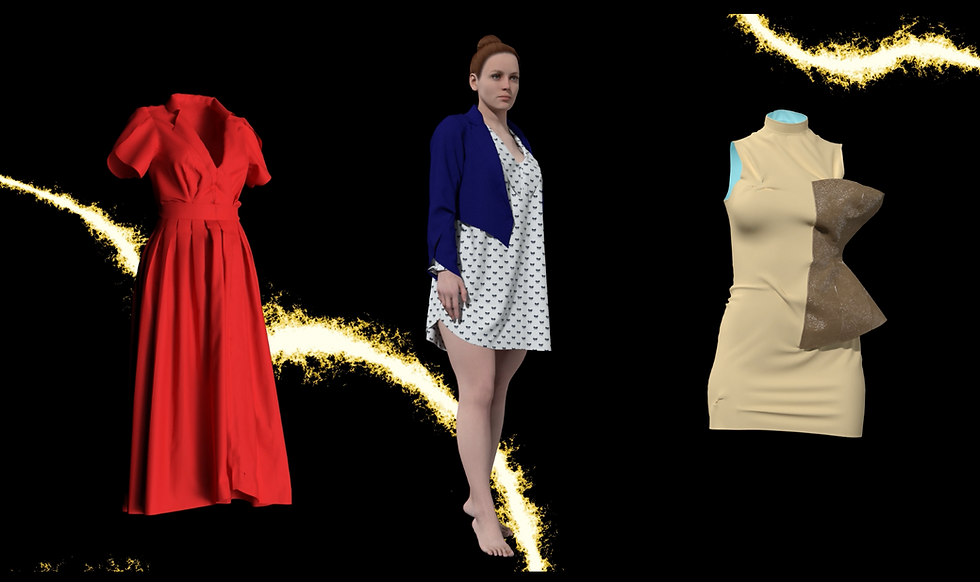
The first time I watched my garments move, nothing worked the way I expected.
I'd been imagining something close to watching a character in a video game, the way clothes render smoothly once someone hits dress. It was supposed to be a magical moment of confirmation. Instead, the fabric was clinging in the wrong places, colliding where it had no business colliding, getting sucked into what I can only describe as digital black holes. Wadding up in knots. Slipping clean off the avatar's body. That was my introduction to VStitcher simulation, and in retrospect, it was the most honest possible preview of everything the program was about to demand of me.
This semester, I completed VStitcher 101, 201, and 301 through Browzwear University and used the software to digitally prototype my junior collection, Sisyphean Ideals of Womanhood, for Advanced Fashion Technology at Belmont University's O'More College of Architecture and Design. If you're not already familiar with VStitcher by Browzwear, it is one of the most advanced and accurate 3D garment simulation and digital prototyping programs in the industry, used by major fashion houses and production teams worldwide. Working in it as a student is, to state it plainly, a lot.
There's something almost poetically fitting about learning a program this demanding while working on a collection called Sisyphean Ideals of Womanhood. If you want to see more about the collection before reading on, you can find it in my portfolio.
The Process
My workflow started where it always does: at the dress form. After drafting initial pattern pieces by draping and flat patterning, I scanned them into VStitcher using a digitizer to bring the physical paper patterns into the 3D CAD environment. From there, I used Browzwear's Fabric Analyzer (FAB) to test my own fabrics, measuring their actual physical properties rather than approximating from a library. Those measurements were applied directly to the pattern in the software, so the simulation would reflect exactly how my specific materials stretch, drape, and respond to movement and weight.
Once the fabric data was in, I digitally stitched each pattern piece together inside the program. That iterative control was one of the most valuable parts of the process. When something wasn't working, I could make pattern alterations without cutting a new set of pieces. But that flexibility also meant there was nowhere to hide from the decisions I was making. Finally, I used Mixamo and Adobe After Effects to animate the avatar and simulate how the finished garments would move in real life. And yes, that's when I met the black holes.
What VStitcher Taught Me About My Own Knowledge
There's a theory that if you truly understand something, you can explain it simply to someone who doesn't. VStitcher raises that standard considerably. The program assumes nothing. Every seam type, every fabric property, every tension setting, every collision parameter, and every positioning decision is a choice the designer must make deliberately and completely. There is no zhuzhing something into place. There is no cutting on the bias by feel and forgetting to notate it. Everything that happens intuitively when fabric is in your hands, things you execute without consciously deciding them, has to be named, understood, and defined with precision.
That was regularly humbling. There are things I do by feel in the studio that I had never had to articulate before, and translating that embodied knowledge into explicit parameters forced me to examine my own understanding in a way that no other tool has. I came out of this semester a more technically articulate designer, including in the places where VStitcher made clear how much I still have to learn. I'm not finished growing into this program. I don't think you ever are.
Why I Almost Didn't Share This
I want to be honest about this, because I think it matters more than I initially gave it credit for.
I was genuinely reluctant to post this work. The comparison I kept making was to how effortless it looks to dress a character in a video game, and I kept returning to a very specific kind of vulnerability: the fear that the visible imperfections in this work would lead people to underestimate what I'm capable of with my hands. There are aspects of physical garment construction I still haven't fully cracked in VStitcher. Putting that on the internet, when I know what I can do in a real workroom, felt like leading with my weaknesses instead of my strengths.
But after considerable thought, I finally reached the opposite conclusion. The fact that this was difficult is exactly the reason it's worth sharing. This is not something generated by AI. This is not a video game character dressed by a single click. It is a painstaking process with complete control over every parameter in the simulation, down to the avatar herself, which I adjusted to my own measurements. Every element had to be decided, understood, and entered by me. The chaos at the beginning, the fabric in knots, the invisible voids, the hours of troubleshooting, that was just what it actually looks like to learn something this hard.
The final result still isn't perfect, but I have come a long way from where I started. I'm finally beginning to realize how important it is to celebrate little wins and milestones along the path of progress, rather than holding out for absolute perfection. I learned so much in just three months, and for that, I'm proud of myself. I look forward to sharing continued progress and sneak peeks as I use Browzwear VStitcher to develop my O'More College of Architecture and Design Spring 2027 Senior Fashion Collection, which will debut at Belmont University in April 2027.
If you're among the few who made it to the end of this post, especially those well-acquainted with Browzwear and VStitcher, you get the struggle; the learning curve of this program. This post is meant for you, and I hope it resonates. If you've already mastered working with 3D garment simulation programs, maybe this story will give you a chuckle and remind you of your own past experiences. And if you're new to the fashion industry and currently fighting the uphill battle of learning 3D CAD, I hope you find solace in knowing you aren't alone. Remember: You will get through this, you will be better for it, and don't forget to celebrate your progress as you go.
Sarah Andersen is a BFA Fashion Design student at Belmont University's O'More College of Architecture and Design and a Browzwear VStitcher certified designer.


Comments